
The CO-USB Is Back. We Learned a Few Things.

RADIANT | PRODUCT UPDATE
Meet CO-USB-A and CO-USB-C. See what we changed in the way we build and test them, and get an honest first look at the upcoming CO-Pro-Plus.

CO-USB-A: the direct-plug USB-A version of Radiant's rebuilt active visual CO detector.
About 1,500 CO-USB and CO-USB-UP units made their way into the field. That told us something important: a very small, affordable, USB-powered active CO detector could earn a permanent place in the cockpit.
It also taught us where the idea needed improvement.
When a critical LED used in the original products became unavailable, the easy answer would have been to find the closest substitute, restart the old design, and move on. We chose not to do that.
The interruption gave us an opportunity to ask a better question:
What should the next CO-USB tell the pilot—not only when CO is present, but also while the sensor is starting, when the detector is ready, and if something inside it is no longer working correctly?
The interruption gave us a chance to look at the entire customer experience - not only what the detector does when CO rises, but what it tells the pilot at startup, during sensor warmup, after a fault, in bright sunlight, at night, and before the unit ever leaves our factory.
The honest answer is that we had not done every part perfectly.
| The original idea was right. The execution needed to become clearer, more controlled, and easier for customers to understand. |
What we got right - and why we kept it
Pilots did not necessarily want another screen, another app, another battery to charge, or another device demanding attention. Many wanted something simpler: plug it in, put it where it can be seen, and let it quietly watch the cabin.
The original CO-USB offered that. CO-USB-UP adapted the same idea for installations where an upward-facing warning light was easier to see. Together, they proved that active CO awareness did not have to be expensive, complicated, or permanently installed.
They also gave us an assignment.
Simplicity mattered.
The original CO-USB concept was deliberately simple. It had no app, no Bluetooth pairing, no subscription, and no internal battery to remember to charge. It came on with aircraft USB power, stayed out of the way, and provided an active visual warning. CO-USB-UP addressed a real installation issue by reversing the warning lights in cockpits where the original orientation was hard to see.
Those products were successful because they removed reasons to postpone buying active CO protection. They were affordable, easy to understand, and easy to put in an airplane. We are not walking away from that idea. CO-USB-A and CO-USB-C are their direct successors.
What we could have done better
We have not always made our CO product line as easy to understand as it should be. Names and replacement paths overlapped. Availability was not always clear. We also carried products from outside suppliers to fill gaps in the catalog. In at least one case, that left us with a detector we could not calibrate ourselves and could not reliably keep in stock.
That is not the level of control we want in a safety product, and it is not the customer experience we want to provide.
None of this means every earlier product lacked value. It means we sometimes asked customers to sort through complexity that should have been ours to solve. Going forward, the center of the line will be products whose design, firmware, calibration, testing, documentation, and support we can control directly.
Meet CO-USB-A and CO-USB-C
CO-USB-A plugs directly into a USB-A power source. CO-USB-C uses a USB-C connection so the detector can be positioned where it is easier to see. The two models share the same next-generation sensing, warning, and factory-calibration approach. The choice is about installation and placement, not about one detector being more capable than the other.
Both are smaller and thinner than the products they replace. More importantly, both are designed to communicate more clearly.
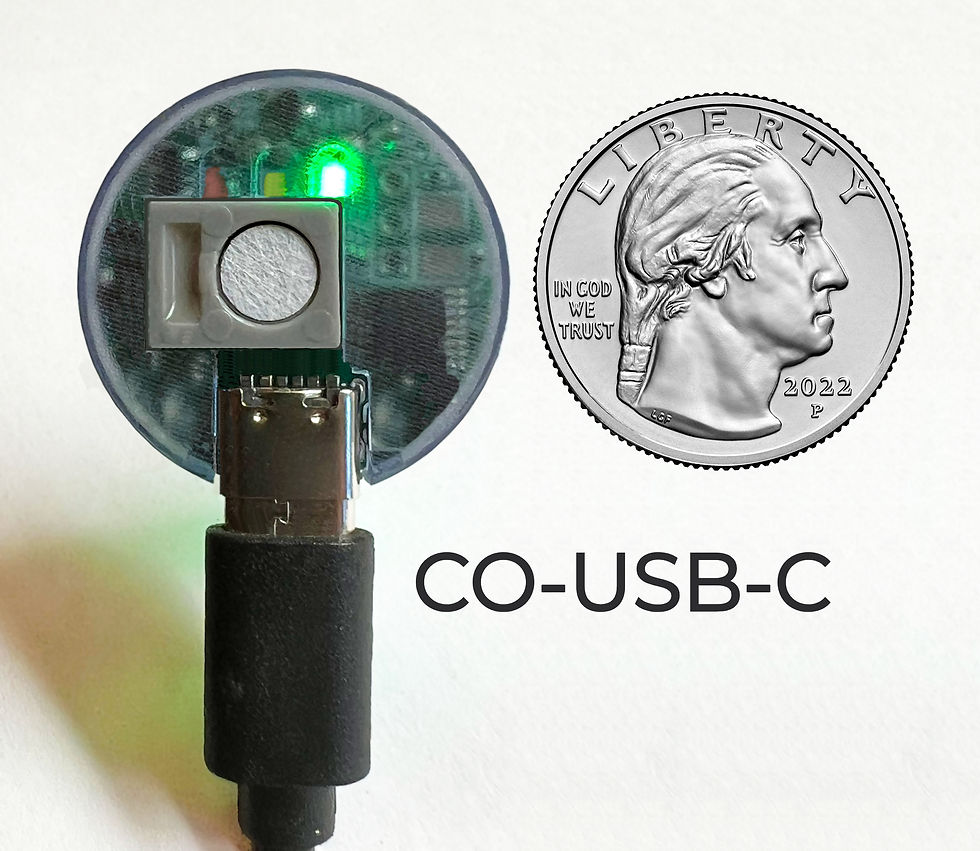
CO-USB-C, shown beside a quarter for scale: the cable-positionable USB-C version.
A visible answer to: Is it ready?
A CO detector should not appear reassuring while it is still warming up or when valid sensor data is missing. The new CO-USB family begins with a green-yellow-red light self-test, followed by a distinct warmup indication. When the warm-up is complete and valid sensor data is present, a steady green indicates the detector is ready, and conditions are normal.
If the detector stops receiving valid sensor data, normal green is removed, and a separate fault pattern appears. That sounds like a small detail. We think it is a fundamental one: a safety product should tell the truth about its own condition.
More information without more cockpit clutter
CO-USB-A and CO-USB-C use a progressive visual language rather than a tiny numerical display. Green confirms normal operation. Yellow tells the pilot that CO has become elevated, and conditions have changed. Red communicates a warning and becomes more insistent as CO rises.
The light output also automatically adapts to the surrounding cockpit lighting. A normal indication that is visible on a bright ramp should not become an unnecessary beacon on a dark night flight.
Every unit must earn its way out of the factory
This is one of the most important changes in the new line: every production CO-USB-A and CO-USB-C is exposed to known carbon monoxide, individually calibrated by Radiant, and checked against our acceptance limits before shipment. If a unit does not pass, it does not ship.
That process takes more time than buying finished detectors by the carton and putting our name on them. We believe the extra work is worth it. For these products, factory calibrated means the customer unit itself was tested - not merely that a sensor vendor published a specification or that one sample from a batch was checked.
Still intentionally simple - and honest about the limitation
CO-USB-A and CO-USB-C are active visual detectors. They do not add an app, pairing process, subscription, numerical display, or internal battery. They are designed to turn on with the aircraft power source, remain in the pilot's normal scan, and communicate changing conditions through light.
That also means placement matters. These are visual products and must be located where the pilot can see them. A pilot who wants an audible warning, a numerical CO display, trend information, or battery-powered portability needs a different kind of product. That brings us to what is coming next.
CO-Pro-Plus is coming next
The current CO Pro is sold out. Aircraft Spruce has zero inventory, and so do we. We are not waiting for another shipment of the old model, and we are not going to pretend that it is temporarily unavailable.
Within the next two or three weeks, we expect to introduce CO-Pro-Plus.
CO-Pro-Plus will carry forward the portable, display-based, audible role of CO Pro while improving the product and the way the pilot interacts with it. It is intended for customers who want more than a visual sentinel: a product that can present CO information and trends, audibly attract attention, and provide useful cockpit functionality during normal flight.
We will publish the complete feature set, specifications, price, and availability when the launch configuration is frozen. We are talking about it now because there is no old inventory to protect and no reason to leave customers wondering whether CO Pro will be restocked. It will not. CO-Pro-Plus is what comes next.
A clearer product line
The direction is becoming much simpler:
Product | Customer role |
CO-Quick | Our opening-price active visual CO detector. |
CO-USB-A / CO-USB-C | The individually calibrated, self-reporting visual successors to the original CO-USB franchise. |
CO-Pro-Plus | The upcoming portable, audible, display-based instrument for pilots who want more information and greater cockpit utility. |
Better products, clearer answers
Customer experience in aviation CO detection is not just a checkout page. It is knowing which product fits the airplane, whether it is actually available, what its indications mean, how it was tested, what its limitations are, and what happens when it is no longer working normally.
We have more work to do. We will not claim otherwise. We are simplifying the line, bringing more of the design and calibration under our control, making product status clearer, and showing more of the work behind the claims.
The original CO-USB idea was right. The execution is now better. CO-Pro-Plus will add the next layer. And we are grateful to the customers who bought and flew those first 1,500 units, told us what worked, told us what did not, and gave us the chance to build the next generation properly.
| We are not promising perfection. We are promising clearer product roles, more direct control, honest availability, and evidence behind the claims. |
Safety Note: CO-USB-A and CO-USB-C are visual advisory products. They supplement, but do not replace, aircraft exhaust and cabin-heat inspection, pilot judgment, the aircraft POH/AFM, or applicable operating procedures. Mount the detector where it can be seen during the normal cockpit scan. |


Comments